





Anesthesia masks are common medical equipment consumables in operating rooms and are an indispensable part of non-invasive ventilation. Below, I will take Trifanz's anesthesia mask as an example to explain the reasons for using anesthesia masks, the correct method of selecting anesthesia masks, and the operation method of using non-cuffed anesthesia masks.
1. Reasons for using anesthesia masks
When general anesthesia is performed on patients, an anesthesia mask is needed. In the initial stage of general anesthesia, the anesthesia mask is connected to the anesthesia circuit to deliver oxygen and volatile anesthetic gases (such as sevoflurane, enflurane, isoflurane, etc.) to the patient. When the patient inhales a sufficient amount of anesthetic gas and enters the "sleeping" state of anesthesia maintenance, the mask will be removed, and the anesthesiologist will intubate the patient or insert a laryngeal mask to establish an artificial airway. In the final stage of the operation, the anesthesia mask will be used again to provide oxygen to the patient and help the patient regain consciousness from the anesthesia state. In some cases, the anesthesiologist will maintain the mask in a fixed position throughout the operation (if the operation time is short), or use a hook and loop to fix the anesthesia mask during a longer operation.
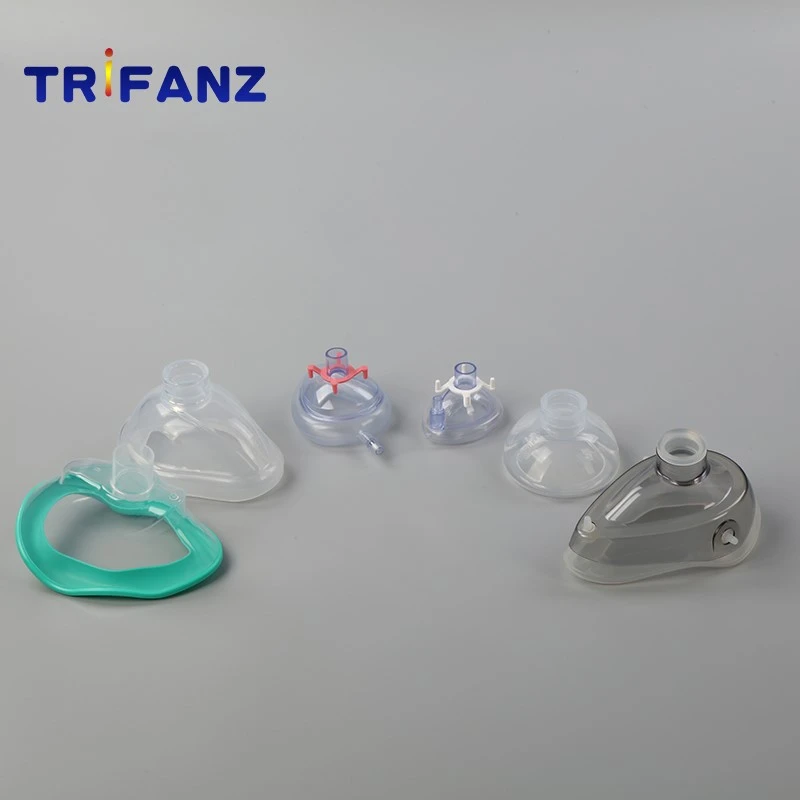
2. How to choose an anesthesia mask?
In any anesthesia process, choosing a suitable anesthesia mask requires many factors to be considered. Some hospitals stipulate that doctors in the hospital must choose disposable anesthesia masks to eliminate cross-infection between patients, but some of these hospitals will reuse anesthesia masks for difficult airway treatment. Most doctors are most concerned about the sealing performance of anesthesia masks. However, despite the great efforts of foreign companies with advanced technology, it is still difficult to produce anesthesia masks that can provide 100% sealing for every patient. Therefore, the practice of anesthesia mask selection is mainly the work of clinicians. Some doctors like anesthesia masks with inflatable cushions, believing that they can bring sufficient sealing pressure and fit tightly to the face. In addition, some doctors like anesthesia masks without inflatable cushions (such as Intersurgical's ECO series of bagless anesthesia masks), believing that their edge design conforms to the anatomical structure of the human face, bringing better sealing performance than bags with masks, while making patients more comfortable when wearing them, especially for those who have undergone facial surgery or have a history of plastic surgery. Doctors often do not need to use greater force to press the mask to form a seal. The soft edge and anti-slip ring of the bagless anesthesia mask, plus the design that conforms to the anatomical structure, bring patients a more comfortable experience and reduce the psychological burden on patients and doctors. Some experts believe that the development trend of anesthesia masks is to be capsule-free, lightweight and environmentally friendly. Such products have already appeared on the market, especially in the entire European medical market, which has very high requirements for medical waste disposal. Traditional PVC anesthesia masks have been eliminated in Europe, replaced by masks made of new environmentally friendly materials PP and TPE (phthalate-free). This anesthesia mask is light and soft, and will not produce dioxins, a carcinogen, when incinerated (if landfilled, its degradation rate is dozens of times that of traditional PVC). In recent years, this advanced concept in the European medical community has begun to influence domestic doctors. They have gradually begun to abandon traditional PVC medical consumables and turn to the path of sustainable development. Although this concept is still in urgent need of promotion, this trend is inevitable.
Nowadays, most manufacturers produce masks in sizes ranging from 0 to 6, a total of 7 sizes. This brings more choices to doctors, but the seven sizes of masks also make it more difficult for doctors to choose. Doctors will spend more time choosing anesthesia masks, and also increase the inventory of warehouses. The increase in consumables inventory means less economic benefits. Some experts believe that seven sizes of anesthesia masks are too many, so according to the conception of clinical experts, 4 sizes of non-bag masks were born.
They believe that masks of size 5 and 6 are not necessary at all. A patient with a larger face does not mean that he needs a wide anesthesia mask. For patients, an anesthesia mask only needs to cover the nose and mouth, so there is no need to cover other redundant parts of the face. Such a smaller volume means lighter weight, less pressure on the patient's face, and compared with a wide bag mask, it reduces the mechanical dead space.
In order to allow medical staff to choose masks suitable for patients more quickly, some anesthesia mask design experts have adopted a color marking method to mark different types of masks. As shown in the figure below, the new 4 sizes cover the old 6 sizes. Medical staff can choose the appropriate anesthesia mask according to the patient's weight and age. In the long run, clinicians only need to rely on clinical experience and remember the corresponding colors of the four masks to quickly select the appropriate size.
Although the anesthesia mask is the most common medical consumable, it has an irreplaceable position in the operating room. How to choose an ergonomic mask is of great significance in improving anesthesia safety and ensuring anesthesia quality.