


Double Lumen Endobronchial Tube
What Is Double Lumen Endobronchial Tube
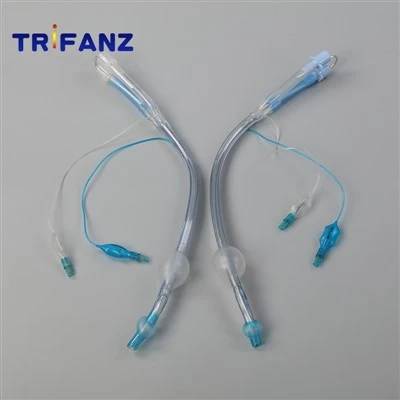
A double-lumen endotracheal tube (also called double-lumen endobronchial tube or DLT) is a type of endotracheal tube which is used in tracheal intubation during thoracic surgery and other medical conditions to achieve selective, one-sided ventilation of either the right or the left lung. There are several conditions that may make one-sided lung ventilation necessary. Absolute indications include separation of the right from the left lung to avoid spillage of blood or pus from an infected or bleeding side to the unaffected side. Relative indications include the collapse of one lung and the selective ventilation of the remaining lung in order to facilitate exposure of the anatomical structures to be operated on in thoracic surgeries, such as the repair of a thoracic aortic aneurysm, pneumonectomy or lobectomy.
Advantages of Double Lumen Endobronchial Tube
Lung ventilation:Double lumen endobronchial tubes allow for independent ventilation of each lung, enabling selective lung isolation during thoracic surgeries.
Prevention of cross-contamination:The separation of the lungs with a double lumen tube helps prevent contamination between the two lungs, reducing the risk of infection and complications.
Enhanced patient safety:Double lumen endobronchial tubes are designed to provide precise and controlled ventilation, contributing to improved patient safety and outcomes in thoracic procedures.
Specialized design:The design of double lumen endobronchial tubes, with two lumens and a cuff for each bronchus, is tailored to provide precise and controlled ventilation during thoracic procedures.



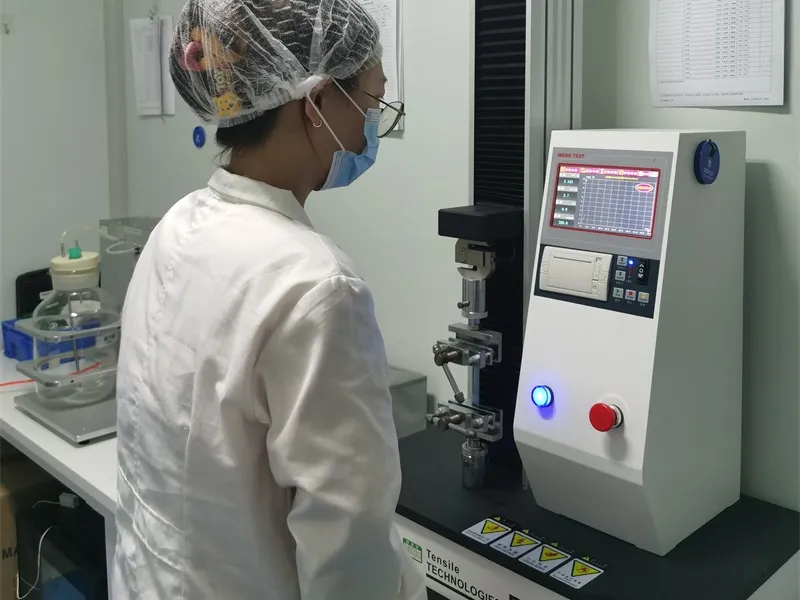
Our factory
HangZhou Trifanz Medical Device Co., Ltd is located in the vibrant bio-industrial park of LinPing, Hangzhou. The park enjoys a beautiful environment and convenient transportation. We have own the production site: 1000 square 100,000 GMP clean workshops.
Our certificate
Passed the CE, ISO13485 system certification; can provide OEM / ODM services.
Experienced team
It has its own R&D team. A group of professional and technical personnel with nearly 20 years of experience in the industry.
Our products
Endotracheal tube, laryngeal mask airway, closed suction catheter,anesthesia breathing circuit and so on.
Development and Description of the Double Lumen Endobronchial Tube
A double lumen endobronchial tube is made up of two small-lumen endotracheal tubes of unequal length fixed side by side. The shorter tube ends in the trachea while the longer one is placed in either the left or right bronchus in order to selectively ventilate the left or right lung respectively. The first double-lumen tube used for bronchospirometry and later for one-lung anaesthesia in humans was introduced. Modifications to the original Carlens tube have been introduced and others. These allow single-lung ventilation while the other lung is collapsed to make Thoracic surgery easier or possible. This may be necessary so as to facilitate the surgeon's view and access to relevant structures within the thoracic cavity. The deflated lung is re-inflated as surgery finishes to check for leakages or other injuries.
These tubes are typically coaxial, with two separate channels and two separate openings. They incorporate an endotracheal lumen which terminates in the trachea and an endobronchial lumen, the distal tip of which is positioned 1–2 cm into the right or left mainstem bronchus. Proper placement of double lumen endobronchial tubes requires considerable clinical experience, various techniques for their insertion having been developed. And there is a small simulator to help in the training of Carlens tube rotation maneuvers. Placement has been found to be easier with the aid of fiber optical equipment such as a bronchoscope. Currently, flexible fiberoptic bronchoscopy examination is recommended before, during placement, and at the conclusion of the use of double lumen endobronchial tubes.
Select the largest double lumen endobronchial tube that fits the bronchus: 41 Fr for most males, 39 Fr for small stature males; 37 Fr for most females, 35 Fr for small stature females. Fully deflate both cuffs before insertion. Lubricate the outside of the tube to reduce the risk of damage during insertion. Lubricate the bronchoscope with aqueous gel to aid its smooth passage through the tube. With the stylet in place, bend the distal 10 cm of the double lumen endobronchial tube 60° anteriorly. This manoeuvre aids tracheal intubation and minimises the risk of rupturing the tracheal cuff as it passes over the patient's teeth. With the tip directed anteriorly, advance the tip of the tube just through the vocal cords. Remove the stylet. Turn the double lumen endobronchial tube sufficiently to rotate the tip to 90° from the midline to help advance the tube past the thyroid cartilage. For a left-sided double lumen endobronchial tube, rotate anticlockwise; for a right-sided double lumen endobronchial tube rotate clockwise. In some circumstances, rotation through 180° may be required to pass the thyroid cartilage.
If a 180° rotation was needed at Step (iv), rotate the double lumen endobronchial tube 90° in the opposite direction so that the bronchial lumen aligns with the appropriate bronchus. Advance the tube until snug. The average depth of insertion in a 170 cm adult is 29 cm, plus or minus 1 cm for each 10 cm increase or decrease in height.4 When advancing the tube, turning the patient's head in the opposite direction to the bronchus being intubated helps the tube advance into the correct bronchus. Perform clinical and bronchoscopic checks to confirm the double lumen endobronchial tube is correctly positioned and lung isolation has been successful. Inflate both cuffs. Consider measuring the cuff pressure (normal pressure 20–40 cm H2O, avoid pressure >40 cm H2O). To deflate the operative lung, clamp the soft silicone connector between the breathing system and the double lumen endobronchial tube on the operative lumen and release the bung on the connector.

For blind insertion of a double lumen endobronchial tube, first, perform a direct laryngoscopy and visualize the vocal cords. Visualization of the vocal cords is important as these tubes are large and placement more challenging than placing an SLT. Once the vocal cords are visualized, gently advance the double lumen endobronchial tube with the tip of the bronchial concave curve facing anteriorly through the vocal cords until the bronchial cuff passes through the cords. The tube is then turned 90 degrees to the left when using a left-sided double lumen endobronchial tube, and to the right when using a right-sided double lumen endobronchial tube, and advanced until it meets resistance. Once the double lumen endobronchial tube is well positioned, inflate the tracheal cuff and ensure ventilation of both lungs by both inspection and auscultation. Verify correct placement by checking ventilation through the bronchial lumen. First, inflate the bronchial cuff 1ml at a time until leak stops. Clamp off gas flow through the tracheal lumen at the Y connector and open the tracheal sealing cap to air. Check whether you can isolate the other lung through the tracheal lumen, by clamping off the gas flow through the bronchial lumen.
The double lumen endobronchial tube can also be positioned using fiberoptic bronchoscopy. Using a fiberoptic bronchoscope through the bronchial lumen and guiding the double lumen endobronchial tube over fiber-optic scope increases the accuracy of placement. Once inserted, the double lumen endobronchial tube is connected to the ventilator circuit via the double lumen endobronchial tube connector, and the detection of ETCO2 confirms placement in the trachea after both cuffs are inflated to seal leaks. No more than 3 mL of air should be required to create a seal in the bronchial cuff. Cuff pressures should be measured to prevent airway injury. Confirmation of correct positioning of the double lumen endobronchial tube can be done by auscultation or with fiberoptic bronchoscopy. Auscultation and bilateral chest wall movement is first confirmed. On clamping the endobronchial lumen limb connector, breath sounds should be absent from the corresponding side of the lung if the endobronchial lumen is in the correct bronchus. On clamping the endotracheal limb connector and ventilating through the endobronchial lumen, breath sounds should be absent from the opposite side of the chest. Once the double lumen endobronchial tube is in place, confirm correct placement by inserting the fiberoptic scope through the tracheal lumen to verify that the bronchial lumen is in the correct main-stem bronchus and there is no bronchial cuff herniation.
The endobronchial portion is in the correct main bronchus. Left-sided double lumen endobronchial tube should be in the left main bronchus, and right-sided double lumen endobronchial tube should be in the right main bronchus. The bronchial rings should be anterior with the longitudinal fibers posterior to help with side identification. The bronchial cuff should be just visible without cuff herniation over the carina when inflated. The right upper lobe (RUL) bronchus should be identifiable via the right main bronchus with 3 lobar branches (apical, anterior and posterior). Next, the fiberoptic bronchoscope is advanced through the endobronchial lumen. For a left-sided double lumen endobronchial tube, identify the origins of the left upper and lower bronchi (confirm that the tip of the endobronchial orifice is not occluding the left upper or lower bronchi). For a right-sided double lumen endobronchial tube, identify good alignment between the opening slot of the endobronchial lumen relative to the takeoff of the right upper lobe bronchus (to allow ventilation of the right upper lobe bronchus). Identify the bronchus intermedius and the right lower lobe bronchus distally. Fiberoptic bronchoscopy is the gold standard for confirmation of correct placement of a double lumen endobronchial tube. Auscultation alone is unreliable as an indicator of proper double lumen endobronchial tube placement.
Using a bronchoscope to cannulate the bronchus and railroading the tube over the scope. Always place the scope in the bronchial (longer) lumen. A stylet should be used when placing a double lumen endobronchial tube. Always check placement when changes to the patient's position have been made, or changes have been made between normal ventilation and isolated lung ventilation. To assist in cannulating the bronchus, rotate tube toward bronchus that is to be cannulated, turn the patient's head to the opposite side and gently slide the tube down until resistance is felt. To initiate one-lung ventilation, the bronchial cuff is inflated, the lung to be isolated is clamped off at the corresponding connector, the connector is then opened to the atmosphere to allow lung collapse. Lung collapse is most rapid if initiated at end expiration.
Guidelines for Determining the Appropriateness of Double Lumen Endobronchial Tube Size
When the bronchial cuff of a double-lumen endobronchial tube (double lumen endobronchial tube) is inflated using the standard underwater seal technique, testing for air leak is performed before and during bronchial cuff inflation by pressurizing the bronchial side to a peak airway pressure of 25–30 cmH2O while connecting the tracheal side to a 1-cm underwater seal. The double lumen endobronchial tube size has been considered appropriate for the individual patient if the following two criteria are met, some air leak is detected when the bronchial cuff deflated, indicating that the tube was not tightly wedged in the bronchus. Airtight seal of the bronchus is obtained with less than the resting volume, because this cuff may lose its low-pressure characteristics if inflated to a volume larger than the resting volume. However, these guidelines do not cover all the possible situations, so I would like to add a few more to the above criteria.
When the development of a wrinkle in the cuff creates a channel for gas to escape around the cuff, intracuff pressure must be increased in order to obliterate the wrinkle. Frequently, however, airtight seal could not be obtained despite inflating the double lumen endobronchial tube bronchial cuff to relatively large volumes that resulted in the very high intracuff pressure. If high intracuff pressures and persistent leak ensue with the injection of less than, but near the resting volume, it seems that the bronchial cuff cannot be molded to the bronchus. If some air leak is detected with the bronchial cuff deflated, but high intracuff pressure follows a small change in the cuff volume with persistent air leak, it appears that the double lumen endobronchial tube size is appropriate but relatively large for the bronchus, therefore the wrinkle on the cuff cannot be unfolded. In this case, based on the clinical requirement of watertight isolation, a decision to change for a smaller double lumen endobronchial tube may be made. To prevent ischemic bronchial injury and achieve as much airtight seal as possible, the intracuff pressure should be <44 cmH2O, at which the mucosal capillary perfusion was reported to decrease, and the cuff inflation volume should be less than the resting volume, regardless of whichever comes first.
When air leak is not detected even with the bronchial cuff totally collapsed, there could be two explanations for this. One is that the double lumen endobronchial tube is tightly wedged into the bronchus, in which case the double lumen endobronchial tube should be changed for a smaller one, and the other is that the tube size is appropriate, but the frill-like folds, formed at the ends of the cuff, work as a barrier to leak. One way to differentiate between the two circumstances is to inject a small amount of air much less than the resting volume and check the intracuff pressure: when the intracuff pressure is lower than the pressure that decreases mucosal perfusion, the tube size should be determined to be adequate.
HangZhou Trifanz Medical Device Co., Ltd is located in the vibrant bio-industrial park of LinPing, Hangzhou. The park enjoys a beautiful environment and convenient transportation. It is adjacent to Shanghai, Ningbo and other important ports. The company is an integrated science and technology innovation enterprise, mainly engaged in the research, development, production and sales of medical catheters in the fields of respiration, anesthesia, and severe diseases. It has its own R&D team: a group of professional and technical personnel with nearly 20 years of experience in the industry; own The production site: 1000 square 100,000 GMP clean workshops; among the company's employees, more than 80% of college and university staff account for the company's production and operation activities in strict accordance with national and international requirements to run the quality management system cloud operation, passed the CE, ISO13485 system certification; can provide OEM / ODM services.



Certificate


video
FAQ
We're professional double lumen endobronchial tube manufacturers and suppliers in China, specialized in providing high quality custom service. We warmly welcome you to wholesale cheap double lumen endobronchial tube from our factory.