


Ventilator Circuit
Your Professional Ventilator Circuit Supplier
HangZhou Trifanz Medical Device Co., Ltd is located in the vibrant bio-industrial park of LinPing, Hangzhou. The company is an integrated science and technology innovation enterprise, mainly engaged in the research, development, production and sales of medical catheters in the fields of respiration, anesthesia, and severe diseases.
Our popular product portfolio primarily encompasses endotracheal tubes, laryngeal mask airways, and closed suction catheters, among others.


Why Choose us
Well-Experienced:The company has an in-house R&D team composed of a group of professional and technical personnel with nearly two decades of cumulative experience in the industry.
Quality Management:All production and operational activities are strictly conducted in compliance with the requirements of national and international quality management systems. The company has obtained CE and ISO 13485 certifications.
OEM/ODM Service:The company is capable of providing OEM and ODM services.
Parameter
|
Size |
REF No. |
Length |
Configuration |
|
Anesthesia circuit, Adult (Tube ID2 mm) |
98.06.869 |
0.2m-3m any length customized |
A:1 set |
|
98.06.872 |
A:1 set+C |
||
|
98.06.873 |
A:1 set+E |
||
|
98.06.874 |
A:1 set+C+E |
||
|
98.06.875 |
A:1 set+B+C+E |
||
|
Anesthesia circuit, Pediatric (Tube ID2 mm) |
98.06.861 |
0.2m-3m any length customized |
A:1 set |
|
98.06.864 |
A:1 set+C |
||
|
98.06.865 |
A:1 set+E |
||
|
98.06.866 |
A:1 set+C+E |
||
|
98.06.867 |
A:1 set+B+C+E |
||
|
Anesthesia circuit, Neonate (Tube ID2 mm) |
98.06.885 |
0.2m-3m any length customized |
A:1 set |
|
98.06.888 |
A:1 set+C |
||
|
98.06.889 |
A:1 set+E |
||
|
98.06.890 |
A:1 set+C+E |
||
|
98.06.891 |
A:1 set+B+C+E |
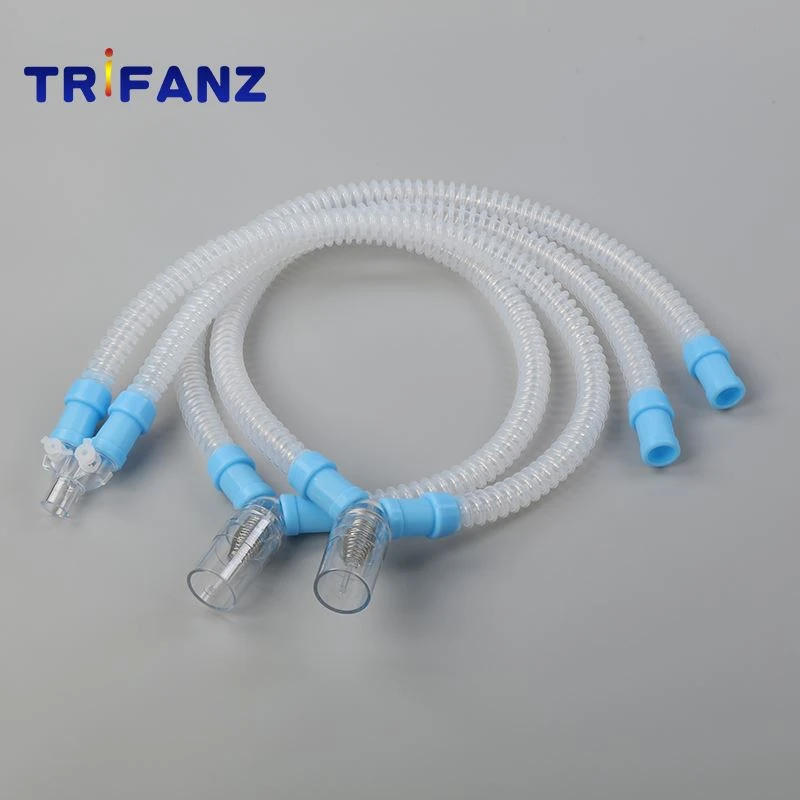
Patent technology of integrated molding ensures high strength, making it not prone to falling off or being separated, while also providing good flexibility.
Length: 0.5-3 meters; any length can be customized.
The product can be sterilized by autoclave at 121℃ for 20 minutes (102.9 kPa) or at 132-134℃ for 4 minutes (205.8 kPa).
It is capable of enduring high temperature and high pressure disinfection processes.
Joints are manufactured using injection molding techniques to prevent gas leakage.
This product supports and cares for patients with severe postoperative respiratory issues.
Free options include a water trap, Y-type joint, L-shaped connector, anesthesia masks, breathing bags, sampling lines, etc.
Maintenance Matters Of Ventilator Circuits
Using triggering systems and high-tech patient breathing recognition to complement these ventilators, the majority of them require tubing, known as circuits, that allow oxygen to flow through them on demand. Along with this ventilator circuit tubing come heaters and humidifiers, suction catheters, filters and therapeutic aerosol generators.
When patients are mechanically ventilated, their airways are subjected to cold, dry air. Because of this, patients often experience dryness in their noses and throats, along with inflamed airways that can cause additional medical difficulties. To prevent such issues, oxygenated air is heated and humidified by using a pass-over humidifier and heating system in the ventilator circuit tubing. When using mechanical ventilators for a patient with an acute respiratory infection (ARI), use of bacterial and viral filters is also recommended.
The circuit tubing is the key part of these medical ventilation systems requiring maintenance. Such tubing is generally made from corrugated plastic with universal connectors that attach the ventilator to an endotracheal tube, non-invasive interface, or tracheostomy tube. Problems that can develop within this circuit include:
Circuit tubes kinking
Fluid gathering in filter
Fluid pooling within the circuit
Tube obstruction
These problems occur due to patients’ biting down on the tubes, sputum entering the circuit or kinks in the plastic tubing. To prevent colonies of unwanted microorganisms from growing inside the ventilator circuit tubing, it’s important to regularly clean and disinfects it.
Contamination occurring within the tubing can be a real concern, especially for patients that require mechanical ventilation on an ongoing basis. Positive cultures of bacteria can grow, feeding off patients’ sputum and the inhaled gas. Because of this, ventilator circuit tubing requires changing every 48 hours. Respiratory therapy equipment that comes in contact with patients’ mucous membranes should also be cleaned thoroughly, with strong disinfectants applied after the initial cleaning.
To keep the ventilator sanitary and sterile, it’s important to wipe down controls and the outside of equipment with disinfectants. Use a sodium hypochlorite solution at 500 parts per million (.05%) for non-metallic surfaces, and a sodium hypochlorite solution of 1000 parts per million (.1%) to disinfect the ventilator circuit tubing, making sure to flush the entire cavity. As the lines are not exposed to patients’ secretions, it’s not necessary to clean the pressure lines when using ventilators between patients.
Normally the tubing through which patients exhale can be removed, with the expiratory end having a valve that controls escaping gas from the circuit. It may also have a water trap or device that measures airflow, or sometimes both. All this tubing should be disassembled before cleaning it with detergent. After rinsing it, the tubing should be disinfected and then sterilized.
Packaging & Shipping
|
Packaging: |
1.1 piece/pouch |
|
2. Suitable quantity to an export carton |
|
|
3. No other packing accessories in regular |
|
|
4. Customer required packing is available |
|
|
Shipping: |
By air, sea, or express |
|
Sample lead time: |
3-5 days |
|
Delivery Detail: |
About 3-25 days after receipt of deposit |
Certificate


FAQ
We're professional ventilator circuit manufacturers and suppliers in China, specialized in providing high quality custom service. We warmly welcome you to wholesale cheap ventilator circuit from our factory.
Breathing Circuit, Anesthesia Circuits Expandable, Anesthesia Closed Circuit